As an Amazon Associate I earn from qualifying purchases. This page contains affiliate links, and I may earn a commission at no extra cost to you.
The Dinner Party Dilemma: Tactile Toy or Genuinely Great Game?
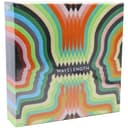
Most party games fall into one of two traps. They are either crude fill-in-the-blank card decks that exhaust their shock value after three rounds, or cerebral deduction games that leave half the room feeling quietly interrogated. CMYK Wavelength attempts to occupy a very different space: a social guessing game built around a massive, tactile plastic dial and subjective scales ranging from "Hot to Cold" to "Underrated Actor to Overrated Actor."
Co-designed by Wolfgang Warsch, Alex Hague, and Justin Vickers (the minds behind The Mind and Monikers), the game tasks two teams with reading each other's minds. A clue giver draws a spectrum card, secretly spins a hidden target wheel, checks where the bullseye landed behind a plastic shield, and gives a single clue to steer their team toward that exact point on the dial. If the scale is "Rough to Smooth" and the target sits at roughly 80% towards "Smooth," saying "Fine Sandpaper" will likely trigger ten minutes of impassioned, semi-serious bickering from your friends.
At a typical retail price hovering between £30 and £38 on amazon.co.uk, it costs roughly double what a compact deck-in-a-box party game commands. This guide breaks down the physical hardware, actual table dynamics, rules friction, and how it stacks up against standard genre heavyweights to determine if it earns its table space.
Build Quality and the Physical Dial
The centrepiece of CMYK Wavelength is its custom plastic dial mechanism. Unlike card games that rely strictly on tabletop card grids or dry-wipe markers, this game lives or dies by the engineering of its plastic console.
The console features a rotating wheel with an internal, multi-coloured scoring target (worth 4, 3, or 2 points depending on proximity to the centre), a sliding plastic screen that conceals or reveals the target wedge, and an external red pointer knob that the guessing team turns. Based on verified owner reports and manufacturing teardowns, the unit is surprisingly sturdy. The plastic housing has enough friction in the red dial to prevent accidental slipping when handed across a dinner table, yet it glides smoothly when making fine micro-adjustments.
There is, however, a minor physical caveat worth noting. If players spin the target wheel too violently with the screen closed, light can occasionally catch the edge of the internal target mechanism if your room has direct overhead spotlighting. For casual family gatherings this rarely matters, but competitive players will want to angle the console slightly away from direct downward ceiling lights when setting up clues.
How Wavelength Actually Plays
The rules take under three minutes to teach. Two teams compete across a track to reach 10 points. On your turn, one player becomes the Psychic, draws a spectrum card from the deck, places it into the slot on top of the dial, opens the screen to see the target zone secretly, closes the screen, and provides a clue.
The true magic of the game happens after the clue is spoken. The psychic must remain completely silent with a poker face while their teammates argue openly about where that clue lands on the continuum. If the spectrum is "Guilty Pleasure to Proud Tradition" and the clue is "Eating an entire tub of ice cream at midnight," one teammate might argue it belongs squarely at 10% on the left, while another insists it is an established festive tradition. That lively back-and-forth is where the game shines.
Once the active team locks in their red dial position, the opposing team gets a quick counter-guess: will the actual target be to the left or to the right of the red pointer? This keeps everyone involved on every turn, eliminating the downtime that plagues many multi-team games. When the psychic slides open the plastic screen to reveal the colourful bullseye, the room erupts in either high-fives or groans.
Specs and Details Comparison
| Product | Player Count | Play Time | Price Band | Core Mechanism | Buy Link |
|---|---|---|---|---|---|
| CMYK Wavelength | 2–12 Players (Best: 4–8) | 30–45 mins | Mid-range (£30–£38) | Analogue dial spectrum debate | See it on Amazon |
| Repos Production Just One Party Game | 3–7 Players | 20 mins | Budget-friendly (Check price) | Cooperative one-word clues & elimination | See it on Amazon |
| Czech Games Edition Codenames | 2–8 Players | 15–30 mins | Budget-friendly (£15–£20) | Spymaster grid deduction & associations | See it on Amazon |
Replayability and Content Depth
One concern buyers have with social debate games is card fatigue. Does the box run out of interesting arguments after three sessions?
The game includes a substantial deck of double-sided spectrum cards spanning hundreds of unique prompts. Because each card has two distinct poles (e.g., "Historically Important" vs "Historically Irrelevant", or "Sad Song" vs "Happy Song"), and because the mechanical target wheel randomly selects a new position each spin, the exact same prompt card feels entirely different on subsequent playthroughs. Rolling "Coffee" for "Hot to Cold" at 90% is trivial; having to give a clue for "Coffee" on "Overrated to Underrated" when the bullseye lands at 15% requires genuine lateral thinking.
Furthermore, the box includes a cooperative mode for smaller groups (2 to 5 players) who want a relaxed after-dinner session without aggressive scorekeeping. In practice, many casual groups abandon the point track entirely after round one, simply passing the dial around the table in a circle because the conversation generated by the clues is satisfying enough on its own.
Top Alternatives to Consider
While the analogue dial offers huge novelty, it is not the only top-tier social game on amazon.co.uk. Depending on your group size, budget, and table setup, these two alternatives offer distinct strengths.
1. Repos Production Just One Party Game
If you want pure, zero-stress cooperation that works effortlessly across three generations from grandchildren to grandparents, the Repos Production Just One Party Game remains an undisputed classic. Instead of dividing the room into competing factions, everyone works together to help one active player guess a mystery word. Players secretly write a one-word clue on dry-wipe easels, then reveal them to each other while the guesser covers their eyes. The twist? Any duplicate clues are immediately wiped off the board before the guesser looks.
This clever elimination rule penalises obvious clues and forces players into quirky, oblique thinking without requiring anyone to operate a bulky plastic frame. It packs into a much smaller box and plays in under 20 minutes, making it ideal for travel or pub tables.
2. Czech Games Edition Codenames
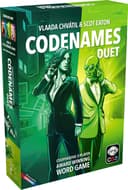
For groups that lean toward clever linguistic puzzles, Czech Games Edition Codenames offers deeper tactical weight. Two rival spymasters give one-word clues linked to a number, attempting to direct their field operatives to contact their team's secret agents from a 5x5 grid of 25 word cards. Connecting seemingly unrelated words like "Doctor" and "Apple" with a single clue of "Health: 2" delivers unmatched satisfaction when your team nails it.
It is significantly cheaper than spectrum-dial games and takes up negligible shelf space. However, it can cause severe "analysis paralysis" if your chosen spymaster tends to overthink their turns in silence, whereas spectrum guessing keeps the entire room chatting continuously.
Who Should Buy CMYK Wavelength?
This game is best suited for dinner party hosts and mixed-age family gatherings who want a striking visual hook to draw reluctant players away from their phones. It requires zero rulebook referencing once the first turn is played, makes people reveal how their minds work without putting anyone uncomfortably on the spot, and scales up to 12 people effortlessly without breaking into disjointed subgroups.
Skip it if you primarily play games in cramped coffee shops or travel frequently on trains, as the large plastic console needs a stable surface and careful packing. Similarly, if your group strictly prefers strategic card games with precise win conditions rather than loose social debates, a word-grid game like Czech Games Edition Codenames remains the safer, more compact investment.
Bottom Line & Final Verdict
The CMYK Wavelength Party Game comfortably justifies its mid-range price tag. Rather than being an empty gimmick, the physical spectrum wheel serves as an intuitive engine for genuinely funny, insightful conversations that feel fresh across dozens of plays.