As an Amazon Associate I earn from qualifying purchases. This page contains affiliate links, and I may earn a commission at no extra cost to you.
Buying for Christmas? Start with our Yoto vs Toniebox (incl. Toniebox Lite) guide, with picks by age.
Toddler speech development thrives on active listening, conversational cadence, and repetition. Yet hand a toddler a tablet or smartphone, and the visual stimulation instantly overrides auditory processing. Passive video viewing simply does not stimulate phonetic imitation and vocabulary retention the way dedicated, screen-free spoken word audio does.
Audio players designed specifically for young children bridge this gap. By removing glowing screens and algorithmic video feeds, these tactile devices encourage children to listen intently, comprehend narrative arcs, and practise new vocabulary independently. Whether you want to support early speech therapy milestones, introduce a second language at home, or establish a calming bedtime routine without tantrums, selecting the right platform makes a substantial difference to how long the device stays in daily use.
Based on published specifications, audio library breadth, and verified parent and educator feedback, this guide examines the six leading screen-free storytellers and kids' audio systems to help you choose the best match for your child's developmental stage and your family's routine.
Screen-Free Audio Players at a Glance
| Product | Best For | Content Format | Battery / Power | Price Band | Buy |
|---|---|---|---|---|---|
| Yoto Player (3rd Generation) Kids Audio Player | Overall speech, bilingual learning & longevity | Smart NFC Cards | Up to 16 hours (USB-C) | Premium | See it on Amazon |
| Toniebox Audio Starter Set Amazon listing under review | Tactile motor skills & younger toddlers | Magnetic Figurines | Up to 7 hours (Dock) | Mid-to-Premium | Amazon listing under review |
| Lunii My Fabulous Storyteller Amazon listing under review | Interactive decision-making & imagination | Digital Store / Wheel Selection | Up to 8 hours (Micro-USB/USB-C) | Mid-range | Amazon listing under review |
| Yoto Mini Portable Kids Audio Player | Travel, car journeys & older toddlers | Smart NFC Cards | Up to 14 hours (USB-C) | Mid-range | See it on Amazon |
| VTech Storytime with Sunny Currently unavailable on Amazon | Animated routine coaching & interactive songs | Activity Disks | 6 x AA Batteries / Adaptor | Budget-to-Mid | Currently unavailable on Amazon |
| LeapFrog LeapStart 3D Interactive Learning System | Bilingual vocabulary & stylus-guided phonics | Interactive Touch Books | 3 x AA Batteries | Budget-to-Mid | See it on Amazon |
Detailed Product Breakdowns
1. Yoto Player (3rd Generation) Kids Audio Player — Top Pick for Speech & Bilingual Learning
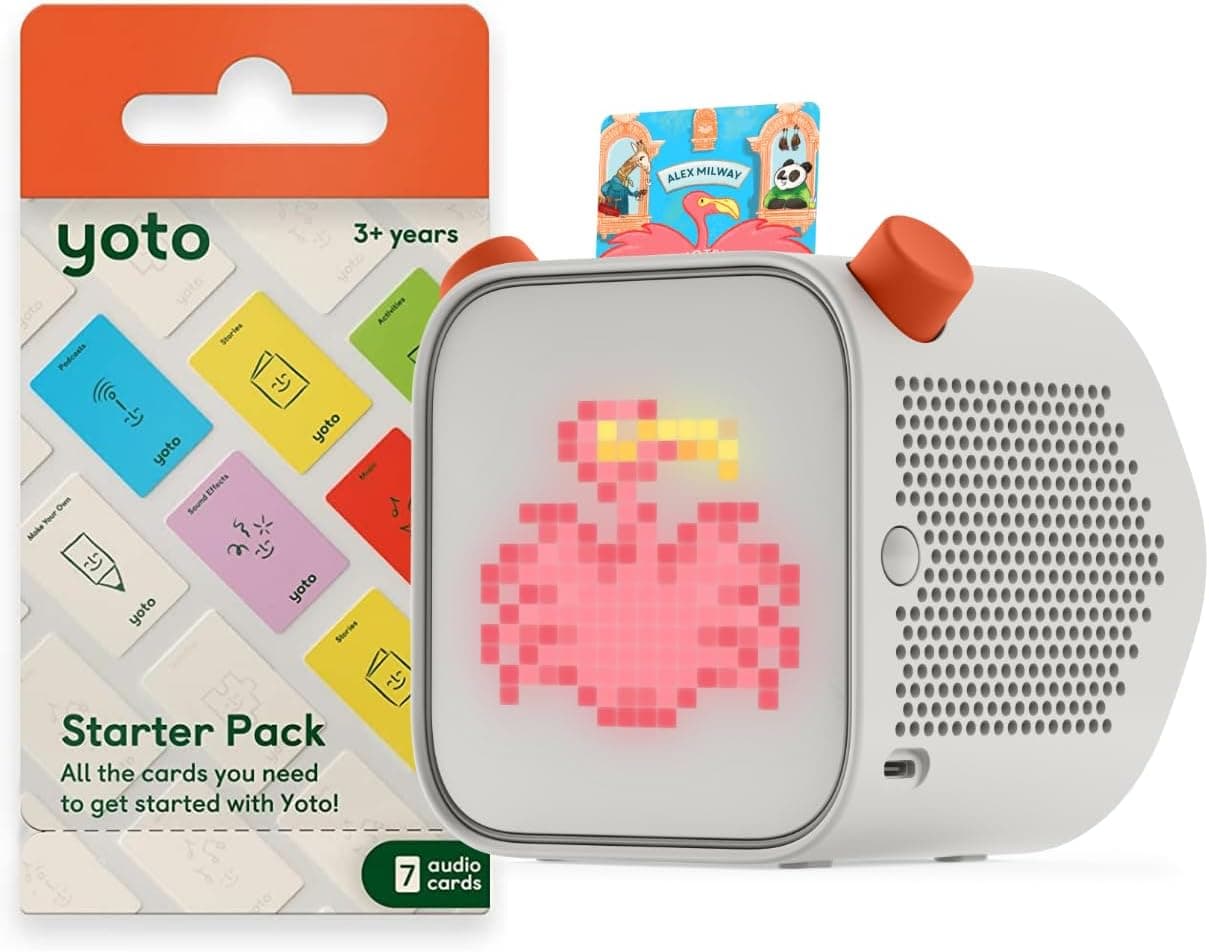
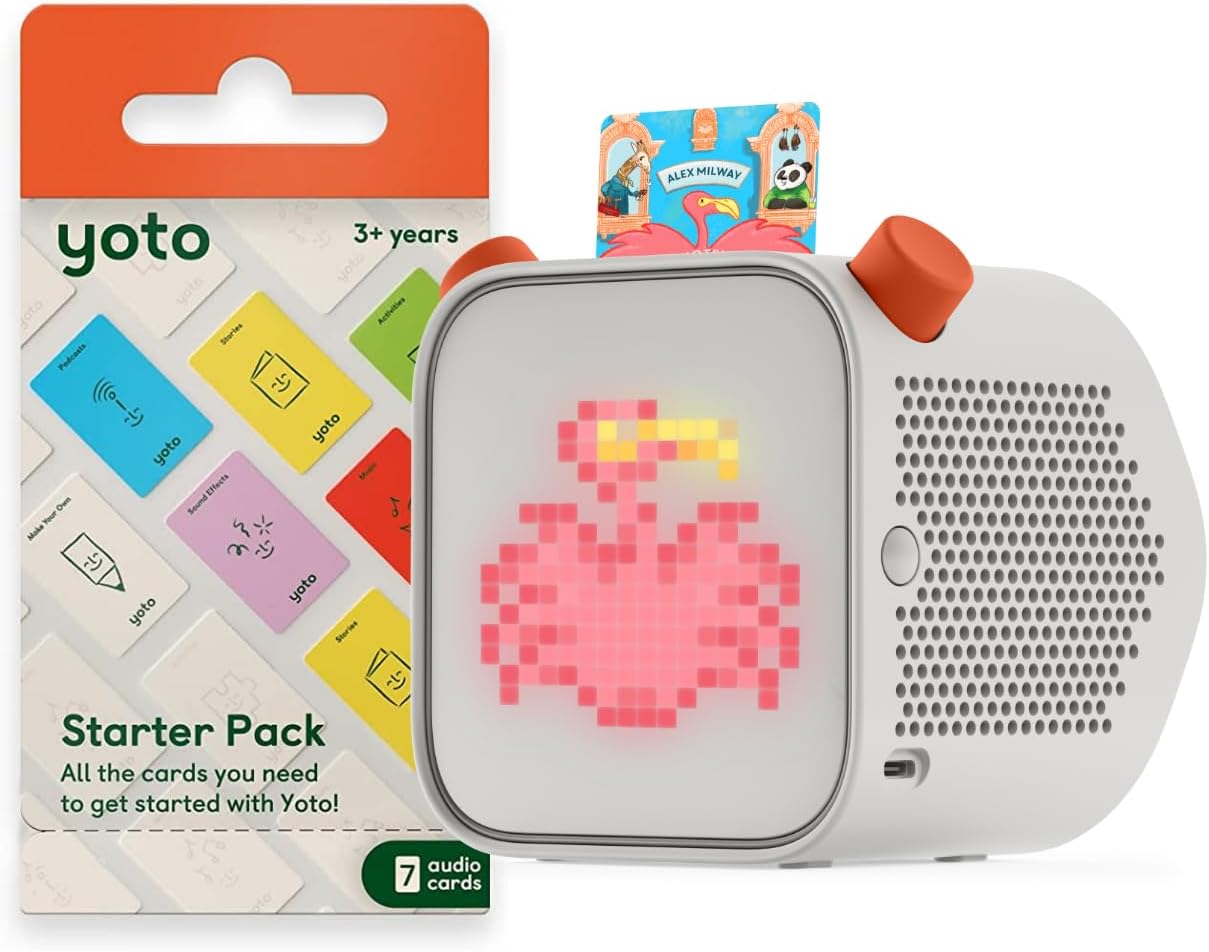
The Yoto Player (3rd Generation) Kids Audio Player stands out as the most versatile, long-lasting audio hub for early childhood development. Instead of using magnetic toys, it relies on durable, credit-card-sized smart cards that slot directly into the top of the player. When a child inserts a card, the track starts immediately; remove it, and playback pauses.
For speech therapy and bilingual immersion, Yoto offers a unique advantage: "Make Your Own" (MYO) blank cards. Parents, grandparents, and speech therapists can record custom voice memos, phonics drills, bespoke family stories, or dual-language audio files via the smartphone companion app and link them directly to a physical card. A child can repeat a target word or phrase dozens of times simply by tapping their personal card into the slot.
Beyond custom content, Yoto's commercial library features over 1,000 cards spanning classic nursery rhymes, Julia Donaldson picture books, French and Spanish vocabulary series, bedtime soundscapes, and ad-free child-safe podcasts. The front face features a charming low-energy pixel display that displays simple contextual icons (such as an apple, a car, or an animal) corresponding to the audio, providing a helpful visual anchor without blue-light screen fatigue.
The 3rd Generation model includes 32GB of internal storage (holding over 600 hours of offline audio once downloaded over Wi-Fi), an integrated room thermometer, an OK-to-wake sleep trainer clock, an ambient nightlight, and up to 16 hours of continuous battery playback via USB-C fast charging.
Pros:
- Exceptional content longevity suitable from age 1 through to age 12
- Make Your Own cards allow unlimited custom speech exercises and bilingual recordings
- Pixel display offers visual comprehension cues without distracting blue light
- Substantial 32GB offline memory holds hundreds of hours for off-grid listening
- Doubles as a nursery nightlight, room thermometer, and sleep training clock
Cons:
- Physical cards can be easily scattered by young toddlers if not kept in a binder
- Higher initial entry price than standalone toy storytellers
2. Toniebox Audio Starter Set — Best for Tactile Motor Play
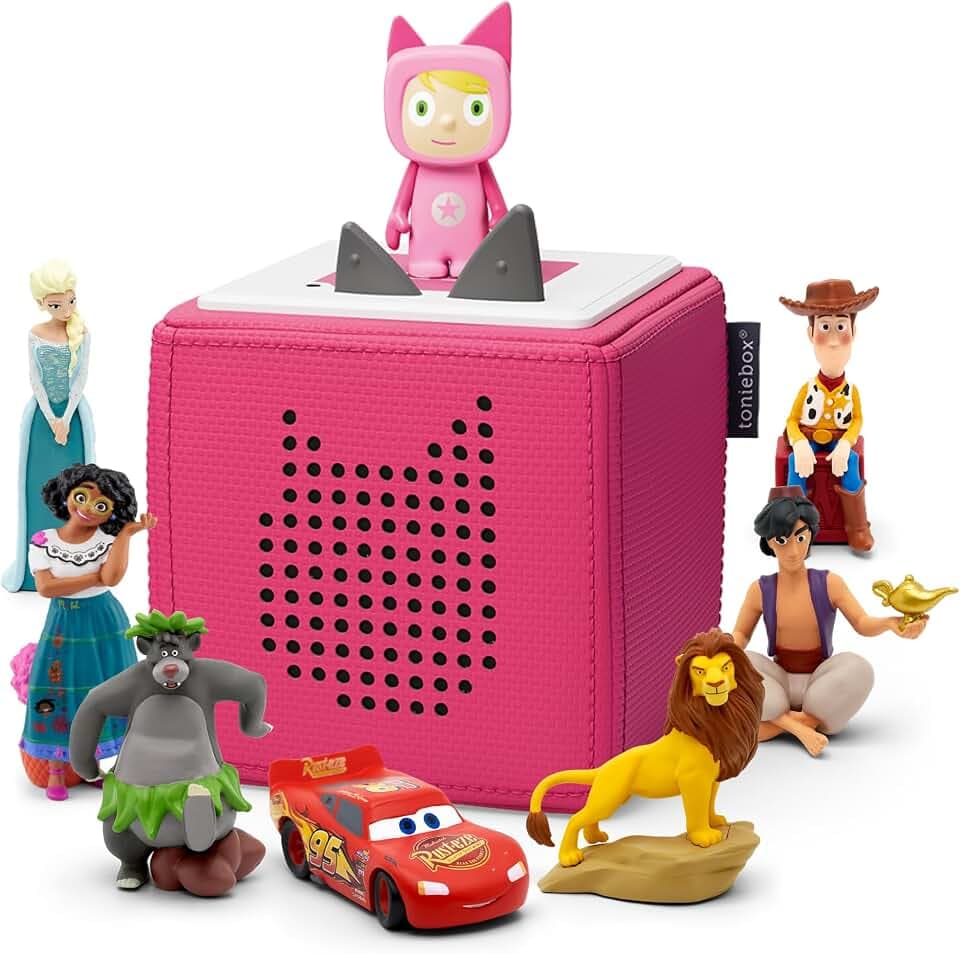
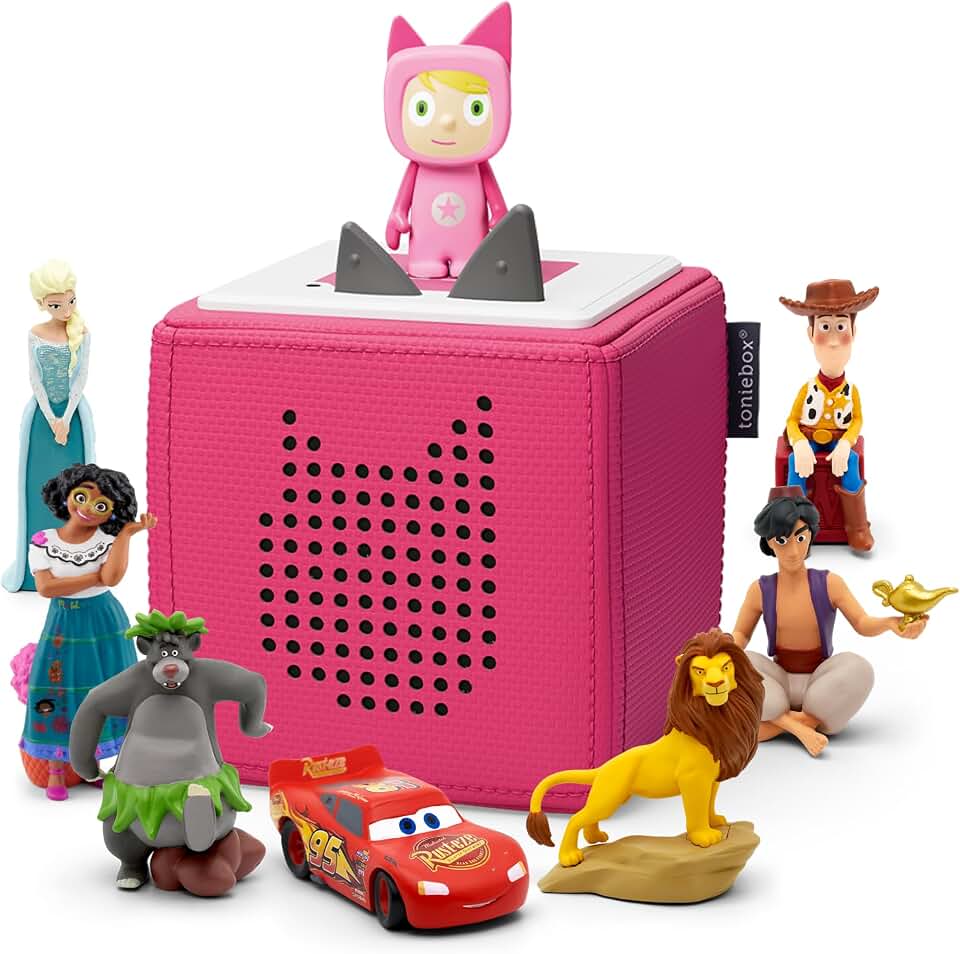
The Toniebox Audio Starter Set Amazon listing under review takes a completely physical, toy-centric approach to audio. The player itself is a soft, padded, shockproof cube without any buttons, screens, or card slots. Children control playback by placing hand-painted magnetic figurines (called Tonies) onto the top of the box. Squeezing the soft rubber ears adjusts the volume, while tapping the sides of the cube skips forward or backwards through chapters.
For younger toddlers aged 18 months to 3 years whose fine motor skills are still developing, the Toniebox provides immediate cause-and-effect satisfaction. Placing a familiar character like Peppa Pig, the Gruffalo, or Disney's Elsa directly on top of the speaker creates an intuitive link between the physical character and the spoken word.
For language practice, Toniebox offers "Creative-Tonies". These figurines allow parents to upload up to 90 minutes of custom MP3 recordings via the Toniecloud or smartphone app. While 90 minutes per figure is more constrained than Yoto's system, it is ample for custom vocabulary lists, nursery rhymes in a mother tongue, or bedtime messages from distant relatives.
The main limitation is shelf organisation and long-term cost. Each figurine generally holds between 30 and 60 minutes of content and costs a significant fraction of an entire book series. Storing dozens of loose figurines can quickly create playroom clutter without dedicated magnetic storage racks.
Pros:
- Extremely rugged, padded, drop-resistant design built for rough handling
- Intuitive physical controls ideal for toddlers under age 3
- Strong character licensing includes Disney, Peppa Pig, and Julia Donaldson favourites
- Creative-Tonies enable custom family recordings and speech practice
Cons:
- Audio content is tied to bulky individual figurines that are awkward to transport
- Creative-Tonies are capped at 90 minutes per figurine
- Battery life of roughly 7 hours is shorter than rivals
3. Lunii My Fabulous Storyteller — Best for Interactive Narrative & Vocabulary Choices
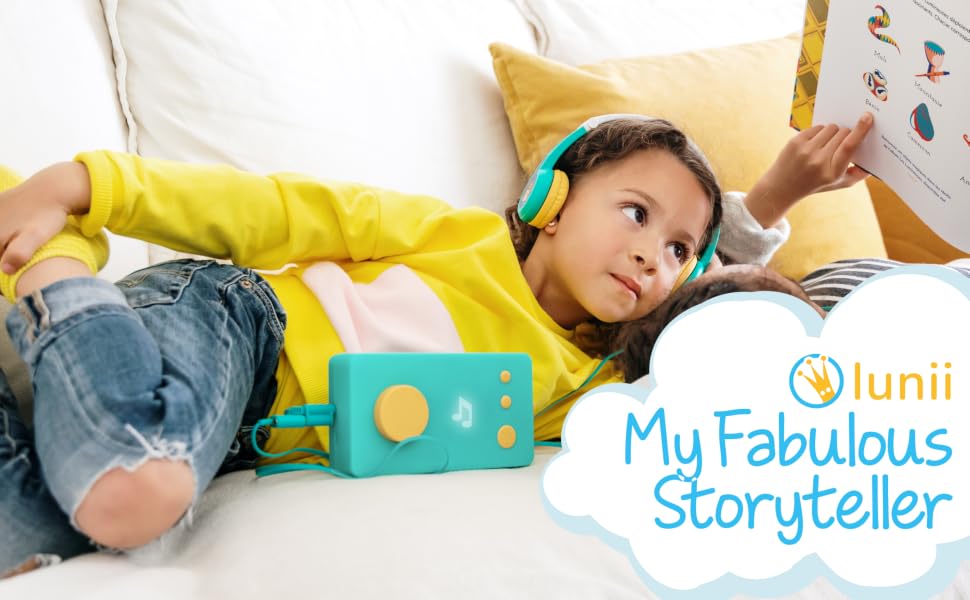
Unlike systems that play static audiobooks, the Lunii My Fabulous Storyteller Amazon listing under review empowers children to build their own stories through structured choices. The device features a vintage radio aesthetic with bright yellow control knobs and a simple, glowing LED icon screen.
When turned on, Lunii prompts the child: "Who is your hero?" The child turns the dial to select a character (like Suzanne or Gaston), presses the big confirmation button, and is then asked to pick a setting (a castle, a forest, or a city), a secondary companion, and an object. Lunii then weaves those choices into a fully voiced, 5-to-10-minute original audio adventure.
This choose-your-own-adventure mechanic is particularly beneficial for language development. It forces active decision-making and cognitive association rather than passive listening. Hearing how different character combinations alter sentence structures and vocabulary contexts helps toddlers internalise syntax and narrative pacing naturally.
The Lunii ecosystem operates via the Luniistore desktop and mobile applications, offering thousands of downloadable stories in multiple languages, including French, Spanish, German, and Italian. It is lightweight, contains no micro-transactions or ads, and pairs seamlessly with child-safe volume-limited headphones for quiet listening in cars or restaurants.
Pros:
- Active, choice-driven storytelling fosters language comprehension and logical sequencing
- No loose parts, cards, or figurines to lose in transit
- Extensive multilingual story catalogue, particularly strong in European languages
- Lightweight, portable design with simple, chunky tactile dials
Cons:
- Lacks a microphone for recording custom parent or speech therapist audio
- Content is primarily Lunii-exclusive narratives rather than mainstream licensed audiobooks
4. Yoto Mini Portable Kids Audio Player — Best for Travel & Language on the Move
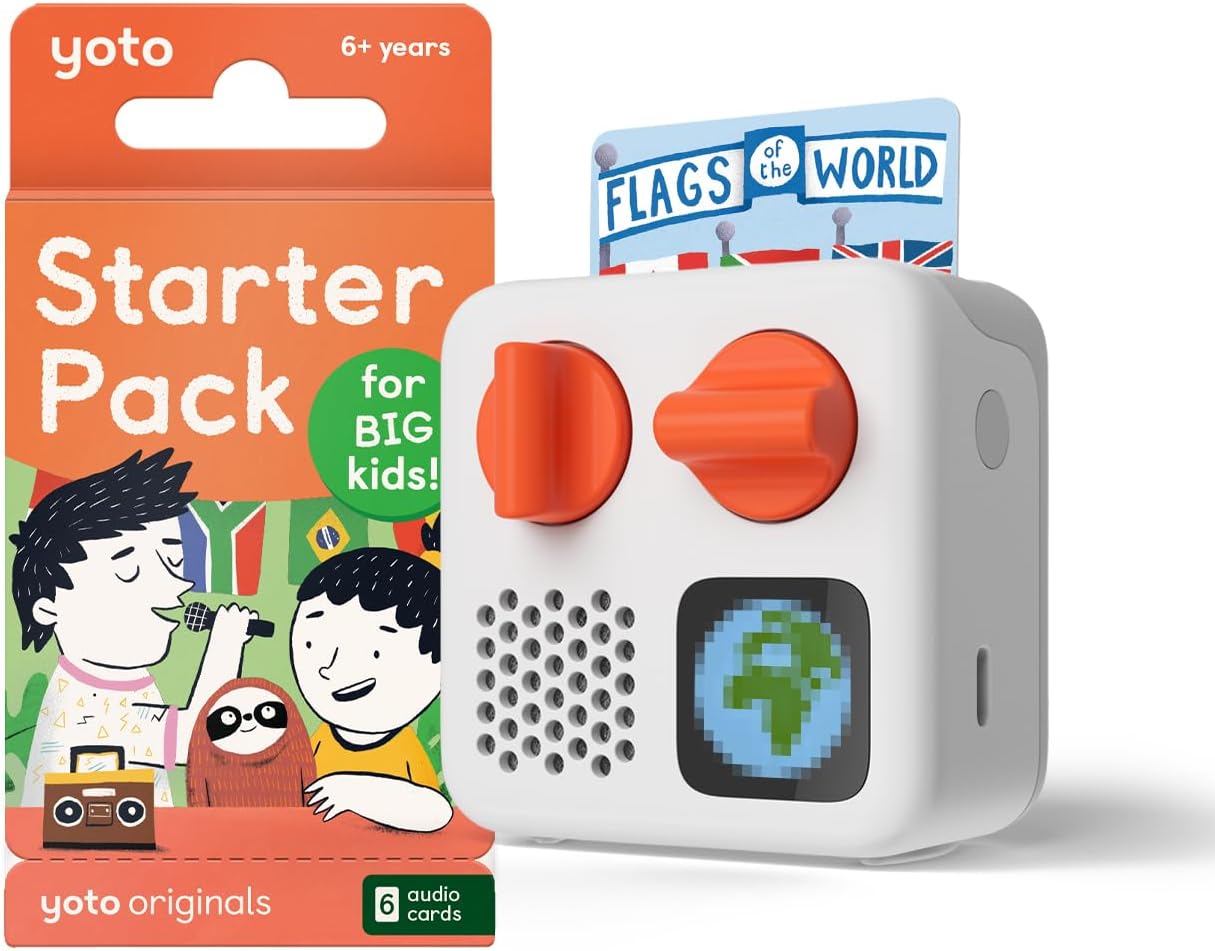
The Yoto Mini Portable Kids Audio Player takes the entire smart-card ecosystem of the full-sized Yoto Player and packs it into a pocket-friendly, palm-sized chassis. It uses the exact same NFC cards, meaning any speech therapy cards, bilingual modules, or novel collections you purchase for one device work instantly on the other.
For families who spend significant time travelling, commuting, or doing speech exercises outside the home, the Mini is an outstanding tool. It features tactile orange control dials, an informative micro-pixel display, a standard 3.5mm headphone jack, USB-C fast charging, and up to 14 hours of playback per charge. Fitted with a protective silicone Adventure Jacket, it handles drops and bumps with ease.
The audio quality through the built-in speaker is remarkably crisp and articulate for its compact dimensions, ensuring that consonants, phonemes, and subtle voice inflections remain clearly audible during vocabulary drills. While it lacks the nightlight and room thermometer of the 3rd Gen home unit, its sheer portability makes it one of the most practical everyday speech companions on the market.
Pros:
- Fully compatible with the extensive Yoto card and Make Your Own card library
- Ultra-compact footprint fits easily in car cup holders, prams, and backpacks
- Clear acoustic reproduction makes speech sounds easy to decipher
- Robust 14-hour battery life with modern USB-C charging
Cons:
- Does not include the ambient nightlight or room thermometer found on the full-sized model
- Small form factor requires a silicone jacket for optimal drop protection
5. VTech Storytime with Sunny — Best for Animated Expression & Routine Coaching
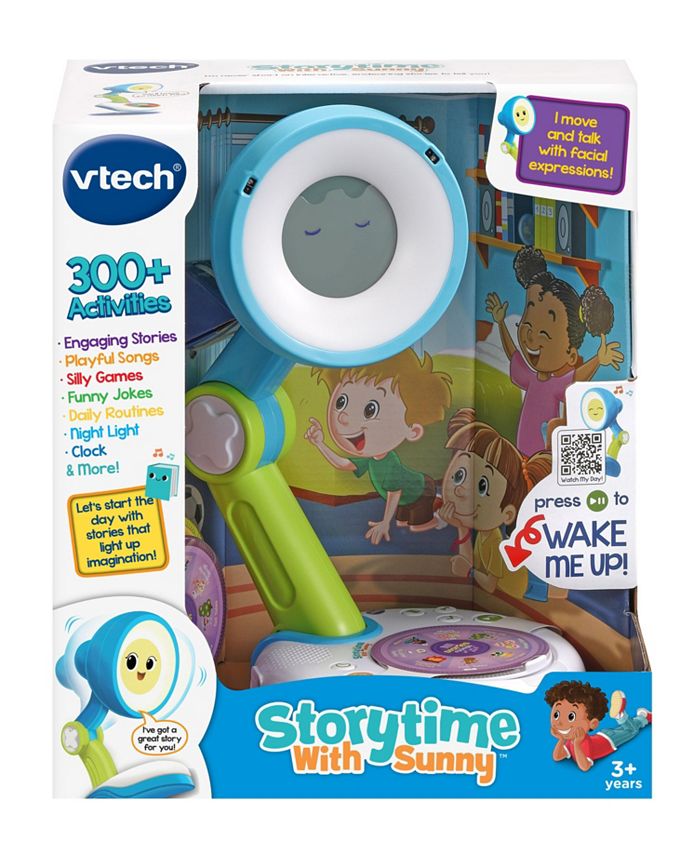
The VTech Storytime with Sunny Currently unavailable on Amazon introduces an expressive animated character named Sunny, shaped like a friendly animated lamp. Sunny features a glowing animated face, moving expressive arms, and a warm, enthusiastic voice designed to guide toddlers through social-emotional development, bedtime transitions, and basic conversation habits.
Sunny comes supplied with four distinct activity disks containing over 300 activities, songs, jokes, and tongue twisters. When a child inserts a disk, Sunny guides them through silly let's-pretend games, encouraging them to repeat phrases, answer questions out loud, and sing along. This structured conversational back-and-forth is helpful for hesitant toddlers who need engaging prompts to practice vocalisation.
Beyond storytelling, Sunny doubles as a routine coach. Parents can use built-in prompts to remind toddlers about brushing their teeth, tidying toys, and winding down for sleep. It also functions as a gentle alarm clock and glowing nightlight. However, unlike the Yoto or Tonie platforms, Sunny is a closed ecosystem. You cannot download custom audio, add foreign language cards, or upload speech therapy exercises.
Pros:
- Animated facial expressions and physical gestures maintain toddler attention
- Encourages verbal interaction through jokes, tongue twisters, and conversational games
- Includes structured habit reminders for morning and bedtime routines
- Affordable standalone package with no recurring audio subscriptions
Cons:
- Closed content library cannot be updated with custom files or third-party audiobooks
- Relies on 6 AA batteries (mains adaptor sold separately for heavy use)
- Upper age limit is narrower (primarily appeals to ages 3 to 5)
6. LeapFrog LeapStart 3D Interactive Learning System — Best for Direct Phonics & Dual-Language Word Matching
The LeapFrog LeapStart 3D Interactive Learning System bridges the gap between pure audio storytellers and structured reading readiness tools. Housed in a durable clamshell carry-case, the system holds physical spiral-bound activity books that a child interacts with using an attached ergonomic stylus.
When the child taps the stylus on any word, image, or letter in the book, the device instantly plays the correct phonetic sound, word pronunciation, or sentence aloud, paired with subtle 3D-like animations on the embedded pop-up screen. For toddlers learning to match spoken sounds to printed text, this multi-sensory feedback loop is remarkably effective.
LeapFrog offers specific bilingual titles, such as the *Learning Friends 200 Words in English & Español* activity book, allowing children to tap an object to hear its name pronounced in both English and Spanish. This direct association provides a level of vocabulary drilling that purely audio-based players cannot match. The trade-off is that it requires physical sit-down engagement at a desk or lap, rather than passive ambient listening during free play or bedtime.
Pros:
- Direct audio-to-print mapping accelerates phonics recognition and vocabulary building
- Dedicated bilingual English and Spanish learning books available
- Sturdy clamshell design with built-in carry handle and stylus storage
- Over 70 replayable interactive activities per book tier
Cons:
- Requires a computer connection with internet to download audio for new physical books
- Operates on 3 AA batteries rather than an integrated rechargeable cell
- Not designed for bedtime background audio or continuous hands-free listening
What Speech Educators & Language Parents Look For
When selecting a screen-free audio device to support speech therapy milestones or bilingual immersion, several technical factors influence everyday efficacy:
1. Acoustic Clarity vs Heavy Bass
Many general-purpose Bluetooth speakers emphasize low-end bass, which can muddy mid-to-high frequency consonants like s, th, f, and p. Dedicated players like the Yoto Player (3rd Generation) Kids Audio Player and Yoto Mini Portable Kids Audio Player are tuned specifically for spoken-word clarity, ensuring that subtle phonemes and vocal intonations remain sharp and easily distinguishable for young ears.
2. Customizable Content Support
For children in speech therapy or families raising bilingual children in a minority language, off-the-shelf English audiobooks are rarely sufficient. The ability to record custom speech drills, upload mother-tongue audio tracks, or link podcast feeds via Yoto's Make Your Own cards or Toniebox's Creative-Tonies makes the device far more valuable than a closed-catalogue system.
3. Tactile Feedback and Agency
Toddlers learn through tactile interaction. Having physical objects (cards, figurines, or dials) gives the child independent agency over their environment. When a child can physically pause, restart, and choose their own stories, they take ownership of their listening experience, leading to higher engagement and longer attention spans.
Alternatives to Consider
If you are looking for alternatives tailored to specific budget or developmental scenarios:
- For Budget Interactive Learning: The LeapFrog LeapStart 3D Interactive Learning System offers the most affordable structured phonics drills and bilingual vocabulary books without requiring an ongoing library subscription. LeapFrog LeapStart 3D Interactive Learning System
- For Maximum Portability: The Yoto Mini Portable Kids Audio Player gives you access to the entire Yoto card library in a rugged, pocket-friendly package that excels in car seats and pushchairs. Yoto Mini Portable Kids Audio Player
Frequently Asked Questions
Can screen-free audio players genuinely help with toddler speech delays?
Yes. Spoken-word audio exposes toddlers to rich vocabulary, proper syntax, and expressive cadences without the overstimulating visual effects of video. By listening to repetitive nursery rhymes, audiobooks, and custom speech recordings, toddlers are encouraged to focus on auditory processing and vocal imitation.
How do bilingual families get the most out of these devices?
Platforms offering open recording systems—most notably Yoto with its Make Your Own cards and Toniebox with Creative-Tonies—allow parents to record stories, vocabulary lists, and songs in their native language. Additionally, Lunii and Yoto have dedicated multi-language stores offering native French, Spanish, German, and Italian content.
Are physical cards or figurines better for a 2-year-old?
For children under 3 years old, Toniebox figurines are often easier to grasp and place independently thanks to their chunky size and magnetic base. However, Yoto cards are much easier to store, take up far less space during travel, and accommodate longer, more complex audio as the child grows past toddlerhood.
Do these audio players require a continuous Wi-Fi connection?
No. While initial setup and content downloading require a Wi-Fi connection, both Yoto and Toniebox store audio locally on their internal memory once downloaded. Devices like Lunii and LeapStart download content via computer or USB cable, operating completely offline during regular use.
Final Verdict
For long-term educational value, unmatched library versatility, and custom recording capabilities that directly support speech development and bilingual learning, the Yoto Player (3rd Generation) Kids Audio Player is our top recommendation. Its combination of 32GB offline storage, crystal-clear vocal reproduction, customisable smart cards, and integrated bedtime features makes it a tool that grows with your child from first words well into primary school.